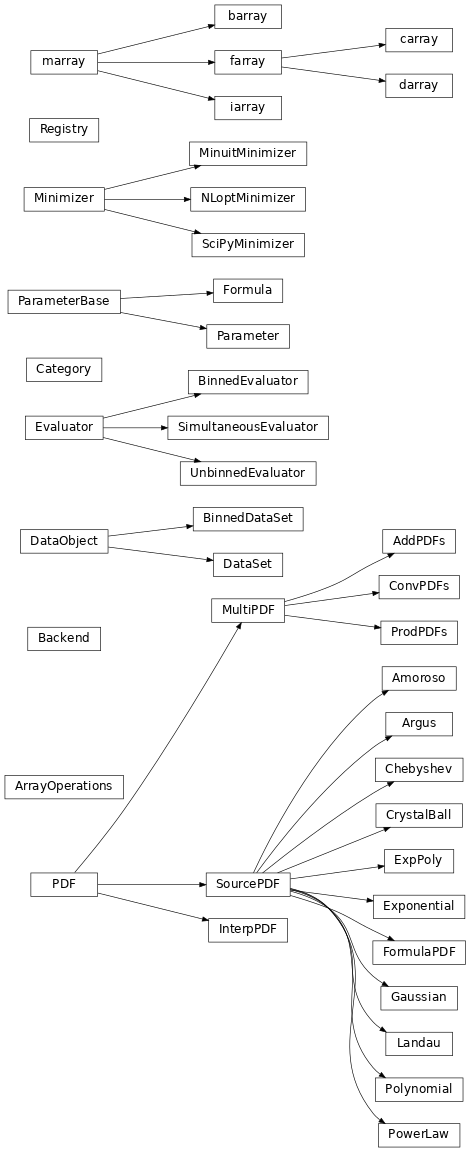
AddPDFs(name, pdfs, yields) |
This special PDF defines the sum of many different PDFs, where each of them is multiplied by a factor. |
Amoroso(name, x, a, theta, alpha, beta[, …]) |
Create a new PDF with the name, parameter related to the data and the argument parameters. |
Argus(name, x, mu, c, p[, backend]) |
Create a new PDF with the name, parameter related to the data and the argument parameters. |
ArrayOperations(backend, **kwargs) |
Build the object to do operations within a backend. |
Backend([btype]) |
Object used in order to do operations with objects of the minkit module. |
BinnedDataSet(edges, gaps, pars, values) |
A binned data set. |
BinnedEvaluator(fcn, pdf, data[, constraints]) |
Proxy class to evaluate an FCN with a PDF on a BinnedDataSet object. |
Category(fcn, pdf, data) |
Object serving as a proxy for an FCN to be evaluated using a PDF on a data set. |
Chebyshev(name, x, *coeffs[, backend]) |
Build the class given the name, parameter related to data and coefficients. |
ConvPDFs(name, first, second[, range]) |
Represent the convolution of two different PDFs. |
CrystalBall(name, x, c, s, a, n[, backend]) |
Create a new PDF with the name, parameter related to the data and the argument parameters. |
DataObject(pars, backend) |
Abstract class for data objects. |
DataSet(data, pars[, weights]) |
Definition of an unbinned data set to evaluate PDFs. |
Evaluator() |
Object to evaluate an FCN on a set of PDFs and data sets. |
ExpPoly(name, x, k, *coeffs[, backend]) |
Create a new PDF with the parameters related to the data and the slope parameter. |
Exponential(name, x, k[, backend]) |
Create a new PDF with the parameters related to the data and the slope parameter. |
Formula(name, formula, pars) |
Parameter representing an operation of many parameters. |
FormulaPDF(name, formula, data_pars, arg_pars) |
Create a PDF from a simple formula. |
Gaussian(name, x, center, sigma[, backend]) |
Create a new PDF with the parameters related to the data, center and standard deviation. |
InterpPDF(name, data_par, centers, values[, …]) |
Represent the convolution of two different PDFs. |
Landau(name, x, center, sigma[, backend]) |
Create a Landau PDF with the parameters related to the data, center and scale parameter. |
Minimizer(evaluator) |
Abstract class to serve as an API between MinKit and the different minimization methods. |
MinuitMinimizer(evaluator, **minimizer_config) |
Interface with the iminuit.Minuit class. |
MultiPDF(name, pdfs[, arg_pars]) |
Base class owing many PDFs. |
NLoptMinimizer(method, evaluator, …) |
Interface with the nlopt minimizers. |
PDF(name, data_pars[, arg_pars, backend]) |
Build the class from a name, a set of data parameters and argument parameters. |
Parameter(name[, value, bounds, ranges, …]) |
Object to represent a parameter for a PDF. |
ParameterBase() |
Abstract class for parameter objects. |
Polynomial(name, x, *coeffs[, backend]) |
Build the class given the name, parameter related to data and the coefficients. |
PowerLaw(name, x, c, n[, backend]) |
Build the class given the name, parameter related to data and the coefficients. |
ProdPDFs(name, pdfs) |
This object represents the product of many PDFs where the data parameters are not shared among them. |
Registry(*args, **kwargs) |
Extension of a list to hold information used in minkit. |
SciPyMinimizer(method, evaluator, …) |
Interface with the scipy.optimize.minimize() function. |
SimultaneousEvaluator(evaluators[, constraints]) |
Build an object to evaluate PDFs on independent data samples. |
SourcePDF(name, data_pars[, arg_pars, …]) |
This object defines a PDF built from source files (C++, PyOpenCL or CUDA), which depend on the backend to use. |
UnbinnedEvaluator(fcn, pdf, data[, range, …]) |
Proxy class to evaluate an FCN with a PDF. |
barray(array[, length, backend]) |
Array of booleans. |
carray(array[, ndim, length, backend]) |
They can be of complex type. |
darray(array[, ndim, length, backend]) |
Array of floats. |
farray(array, dtype[, ndim, length, backend]) |
Array of floats. |
iarray(array[, length, backend]) |
Array of integers. |
marray(array, dtype[, length, backend]) |
Wrapper over the arrays to do operations in CPU or GPU devices. |